The best opening sentences in novels grab the reader immediately – they introduce character, setting and problem; fire the imagination; and the action is clear:
Give your readers as much information as possible as soon as possible. Readers should have such complete understanding of what is going on … that they could finish the story themselves, should cockroaches eat the last few pages.– Kurt Vonnegut
(Vonnegut’s Breakfast of Champions begins, “This is a tale of a meeting of two lonesome, skinny, fairly old white men on a planet which was dying fast.”)
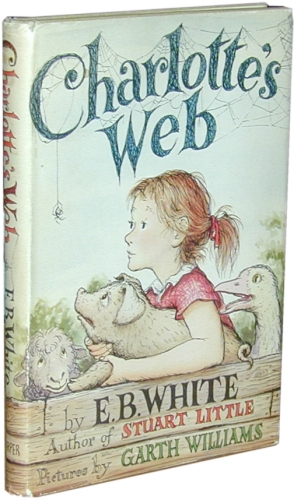
My favourite opening is from Charlotte’s Web by E. B. White, deftly introducing people, place, and problem in one sentence:
“Where’s Papa going with that axe?’ said Fern to her mother as they were setting the table for breakfast.
Test Yourself
Match these classic openings from children’s novels to the titles below.
1. All children, except one, grow up.
2. There was a boy called Eustace Clarence Scrubb, and he almost deserved it.
3.The Iron Man came to the top of the cliff.
4. Here I am, Ralph William Mountfield, banished to my bedroom on Christmas Day.
5. Keith the boy in the rumpled shorts and shirt, did not know he was being watched as he entered Room 215 of the Mountain View Inn.
6. My father is put in the stocks again! Oh! the injustice of it!
7. When Old Tip lost his bark, Uncle Trev had to teach his horse to bark and chase the cows up to the shed for milking.
8. It’s a funny thing about mothers and fathers. Even when their own child is the most disgusting little blister you could ever imagine, they still think that he or she is wonderful.
9. I write this sitting in the kitchen sink.
Titles in random order: The Iron Man, I Capture The Castle, The Voyage of the Dawn Treader, The Mouse and the Motorcycle, Devil-in-the-Fog, Matilda, The More the Merrier, Uncle Trev, Peter Pan
A tower of 10 million atoms would only be as tall as a grain of sand.
Picture a walnut sitting in the palm of your hand – if the walnut was an atom then your hand would have to be the size of the Earth.
Seven octillion atoms [7,000,000,000,000,000,000,000,000,000] make up your body.
Atoms are held together by electromagnetic forces and they are mostly empty inside. You are made of atoms, so you’re mostly empty space too. Atoms have smaller particles inside them. There’s a nucleus in the centre with a cloud of electrons around it. Deeper inside are even smaller particles named gluons, muons, strange quarks, and charm quarks. We live inside a vast universe, but there’s also universe inside us
Anyone can write but editing must be learned. Some books that helped me learn to edit:
Self Editing For Fiction Writers by Renni Browne and Dave King teaches style, dialogue, point of view, ‘show not tell’, character.
The Art of Writing by John Gardner talks about maintaining the ‘dream’ of the story – when the writing draws attention to itself (in a bad way) then the dream is broken for the reader.
Go over and over it…refusing to let anything stay if it looks awkward, phony, or forced.– John Gardner
On Becoming a Writerby Dorothea Brande (1934) suggests a writer begins with the unconscious mind ‘but then the conscious mind ‘must control, combine and discriminate’. That’s editing in a nutshell.
The writer must be as God in his universe — present everywhere and visible nowhere. -Flaubert
“The idea of the extraordinary happening in the context of the ordinary is what’s fascinating to me.” – Chris van Allsburg
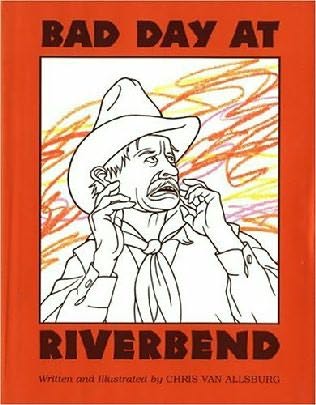
Picture books by Chris van Allsburg are not only beautifully illustrated, the stories are wide open for wide interpretation, which makes them ideal for children. It’s impossible to look at the pictures in Harris Burdick without imagining a story. My other surreal favourites are Bad Day at Riverbend, about a black and white cowboy town attacked by colourful crayons – and The Wretched Stone, about a strange glowing stone which makes the people regress intellectually (TV and digital screens perhaps?).
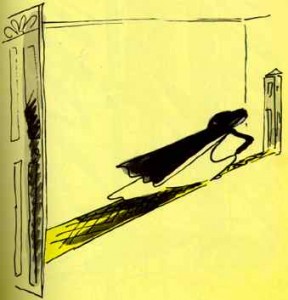
Miss Clavel turned on the light and said, “Something is not right!” – Madeleine
You’ve written a wonderful story and can’t wait to publish it. But wait! Hide your story away for weeks, even months. When you read it again it will be like turning on the light and you’ll see what’s not right – you’ll see with fresh eyes. I’m often too hasty as a writer, but after a pause, I get that Miss Clavel feeling when a scene doesn’t fit or a character speaks in clichés – when the ‘story dream’ is broken.
Illustration from the timeless book, Madeleine, by Ludwig Bemelmans.
Nothing must be out of place. The reader must keep turning pages with no interruptions in the flow. – Darcy Pattison
Go over and over it…refusing to let anything stay if it looks awkward, phony, or forced.– John Gardner
A book needs us desperately. We have to pull it off the shelf. We have to open it up. We have to turn the pages, one by one. We even have to use our imagination to make it work. So, suddenly, that book is not just a book; it’s our book. – Mo Willems
The pictures are not very defined because one wants to be able to have the imagination playing over them. – Quentin Blake
Because they have so little, children must rely on imagination rather than experience. – Eleanor Roosevelt
“I could be bounded in a nutshell, and count myself a king of infinite space…”— Shakespeare (Hamlet)
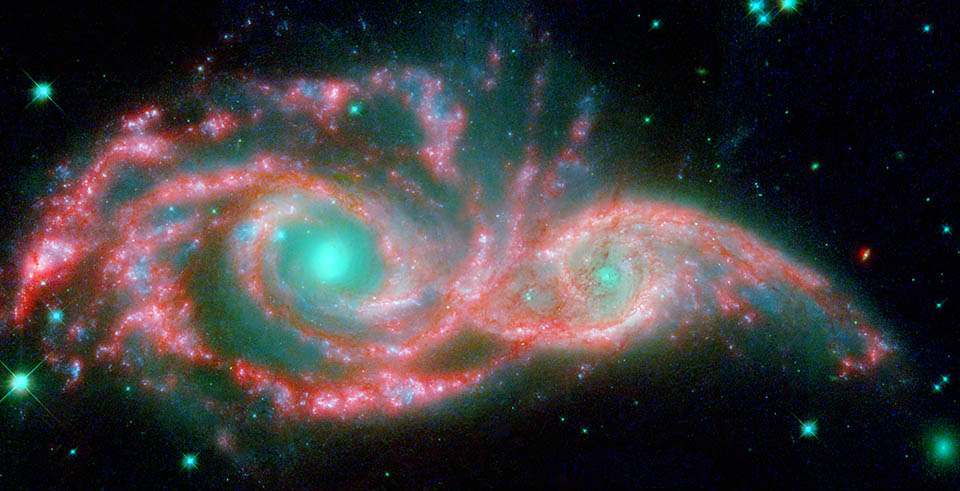
Image: Two merging galaxies, from NASA’s Spitzer and Hubble Space Telescopes. (Credit: NASA, ESA/JPL-Caltech/STScI/D. Elmegreen (Vassar)
Perhaps it is only in childhood that books have any deep influence on our lives. – Graham Greene
In a world that offers children so many digital delights, why bother with books?
1. Books help children understand the world
Books expose children to new ideas and help shape their world view – reading is a meeting of minds.
While reading, we can leave our own consciousness, and pass over into the consciousness of another person, another age, another culture – Maryanne Wolf
2. Books help children understand themselves
Stories give a frame of reference by which they can measure their experiences and feelings.
We read books to find out who we are. – Ursula K Le Guin
3. Books develop children’s imagination
Reading is imagination, and imagination enriches the real world.
Children do not despise real woods because they have read of enchanted woods; the reading makes all woods a little enchanted. – C.S. Lewis
Ultimately a child must want to read. The child who reads for pleasure is forming a wonderful habit – and there’s also pleasure for parents in reading aloud.
Tell all the truth but tell it slant – Emily Dickinson
Science can be difficult to describe: all the maths, jargon, and slippery quantum physics. That’s why analogies and metaphors are so useful in science. And so comforting:
We find it easier to reason by comparing unfamiliar with familiar, falling back on experience, looking for links between things, and seeking out pattern and meaning. – Joel Levy, A Bee in a Cathedral
Science abounds in comparisons: a greenhouse to explain global warming; a cat in a box to illustrate a paradox; and Kepler’s clockwork solar system. One of my favourites compares quantum physics to jazz and general relativety to a waltz:
General relativity is like Strauss — deep, dignified and graceful. Quantum theory, like jazz, is disconnected, syncopated, and dazzlingly modern. – Margaret Wertheim, Physics’s Pangolin
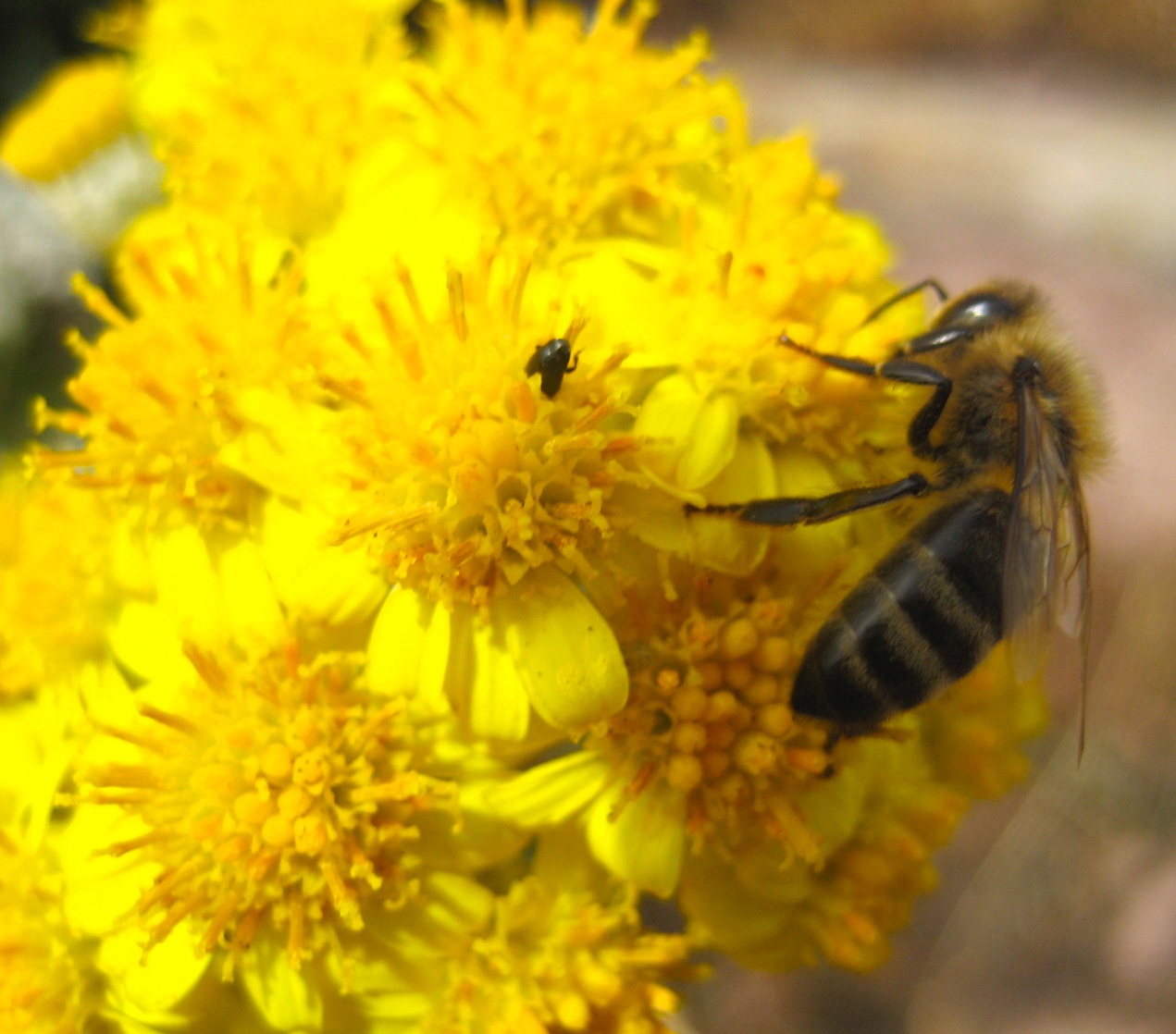
It’s the most important relationship on Earth – everything in Nature depends on pollinators and flowers getting together.
Pollination is ‘a love story that feeds the Earth.’ – Louie Schwartzberg.
For a flower to make seeds and fruit, its pollen (male) must move to an egg (female), usually in another flower – and bees do most of the pollen-moving. The result is a cornucopia of foods from cherries to cashews to coffee. Humans’ relationship with pollinators is also crucial, so let’s provide bees with a variety of flowers, clean water, and poison-free gardens.
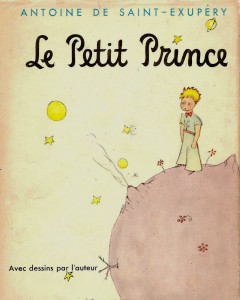
The Little Prince (1943) by Antoine de Saint-Exupéry is a fable about a pilot who crashes in the desert and meets a wise child. It’s one of the world’s most translated books (in 250 languages) and it has parhaps the most intriguing sentence in all of children’s literature:
What is essential is invisible to the eyes.
What is ‘essential’? Is it truth, love, spirit, mystery? These are the questions the story evokes. Saint-Exupéry was a pilot who also wrote great adventure books (eg. Wind, Sand and Stars ).
A great final sentence can offer hope, provoke a smile or trigger a shiver. At its best, it encapsulates the whole literary work. Where are these great last lines from?
“It is not often that someone comes along who is a true friend and a good writer – Charlotte was both.“ (children’s novel)
“Overhead, without any fuss, the stars were going out.” (short story)
“He found his supper waiting for him – and it was still hot.” (picture book)
“All mimsy were the borogroves, and the mome raths outgrabe.” (poem)
“From so simple a beginning endless forms most beautiful and most wonderful have been, and are being evolved.” (non-fiction)
“It is a far, far better thing that I do, than I have ever done; it is a far, far better rest that I go to than I have ever known.” (adult novel)
Five years old, terrified on my first day at school. I sat on the mat and the teacher read Horton Hatches the Egg by Dr Seuss. I was so engrossed I didn’t notice my mother slip out. Horton the faithful elephant helped me get through that day.
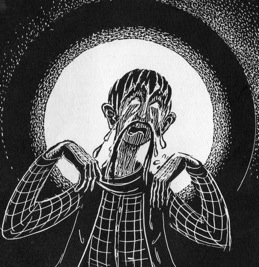
Six years old, and absorbed in a cowboy adventure, Calico the Wonder Horseby Virginia Lee Burton. Gripped by this image of the Stewy Stinker crying in remorse for his wickedness – aware of my own failings perhaps.
Seven years old, and Tintin was my role model for courage and integrity. His stories introduced me to sci-fi and humour, history and politics.
Eight years old, and The Phantom Tollboothby Norton Juster opened the world of word-play to me.
Nine years old, and I devoured Willard Price’s books – pulp adventures with erupting volcanoes, balloon rides and killer anacondas. I wanted to write books as exciting.
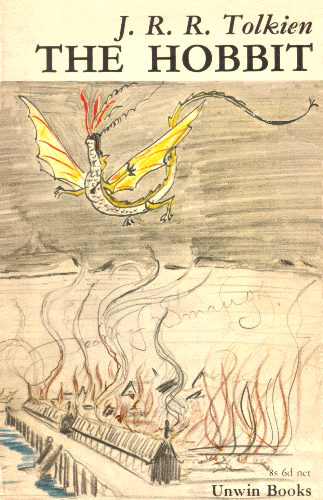
Ten years old, on the ultimate journey with a small hero facing the monstrous Smaug. The Hobbit kindled my imagination more than any other book. It was, as Tolkien said,
‘an escape to a heightened reality- a world at once more vivid and intense.’
Here’s the 1966 version that I once owned, with a cover drawing by Tolkien (link to all Hobbit covers).
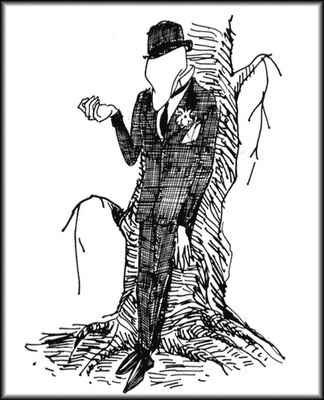
More than any book I read as a child, The Phantom Tollbooth by Norton Juster (who died recently), gave me a love of words – it puns them, pushes them, and plunders their meaning. It’s overflowing with inventiveness: the man who is short, tall, thin and fat, at the same time; an orchestra that plays colours; a city that disappears because nobody cares. And I love the illustrations by Jules Feiffer, such as the faceless timewaster, The Trivium, who has this message for writers:
What could be more important than doing unimportant things? … There’s always something to do to keep you from what you really should be doing.
The story is about a child’s quest to overcome boredom. It’s told with imagination, wit, and wisdom — what more could you want in a children’s book?
I had been an odd child: quiet, introverted and moody. Little was expected from me. Everyone left me alone to wander around inside my own head. When I grew up I still felt like that puzzled kid — my thoughts focused on him, and I began writing about his childhood. – Norton Juster
Fiction should be both canny and uncanny. – Flannery O’Connor
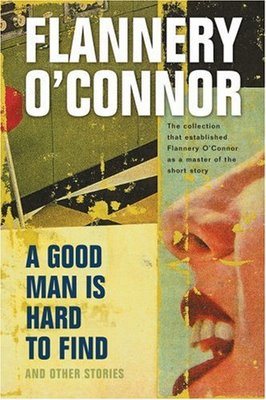
One of my favourite short stories is Flannery O’Connor’s A Good Man Is Hard To Find – it certainly has a powerful ending. Her stories can be dark but there’s always a redemptive thread in them. O’Connor wrote despite the pain of lupus which ended her life at the age of 39. Here are some of her thoughts about the writing process (from Mystery and Manners):
If you want to write well and live well at the same time, you’d better arrange to inherit money.
When I sit down to write, a monstrous reader looms up who sits down beside me and continually mutters, ‘I don’t get it, I don’t see it, I don’t want it.’
Fiction is about everything human and we are made of dust, and if you scorn getting dusty, then you shouldn’t write fiction.
There’s a certain grain of stupidity that the fiction writer can hardly do without and this is the quality of having to stare, of not getting to the point at once.
The artist uses her reason to discover an answering reason in everything she sees.
The writer has to judge himself with a stranger’s eye and a stranger’s severity.
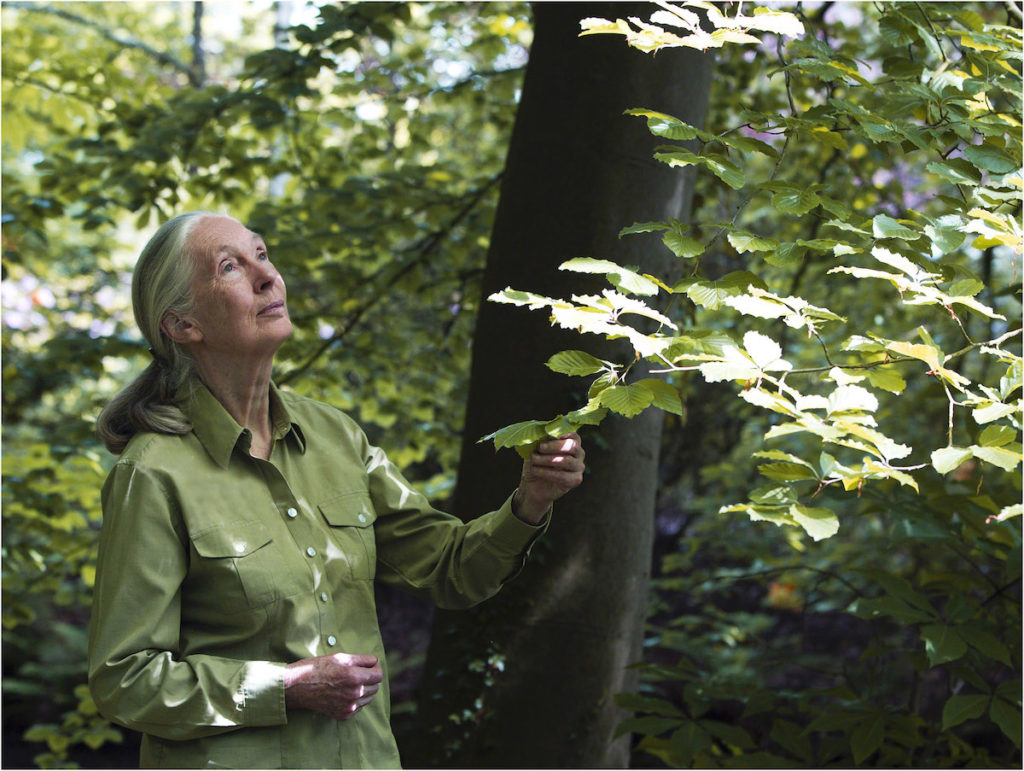
Jane Goodall has had an extraordinary life. As a child she’d sit up her favourite tree and dream of living like Dr Dolittle and Tarzan. Her dreams were realised when she lived alone in the rainforest, getting close to chimpanzees. Her work in the 60s changed the way we see animals. Jane has since travelled the world, fighting for Nature; and her organisation Roots and Shoots empowers young people to care for the planet.
She writes about her love of trees in the foreword of Tree Beings:
When I was deep in the forest I knew a sense of peace and felt a strong spiritual connection with nature. It was from the forest that I learned how everything is interconnected, and how each species of plant and animal has a role to play in the rich tapestry of life. In this book, Raymond Huber shares with us the inspiring stories of some very special people who have not only raised awareness about the importance of trees and forests, but fought to save them.
Read her memoir Reason To Hope, it’s an uplifting story.
Dr. Jane Goodall , DBE, UN Messenger of Peace. Photo: Roy Borghouts
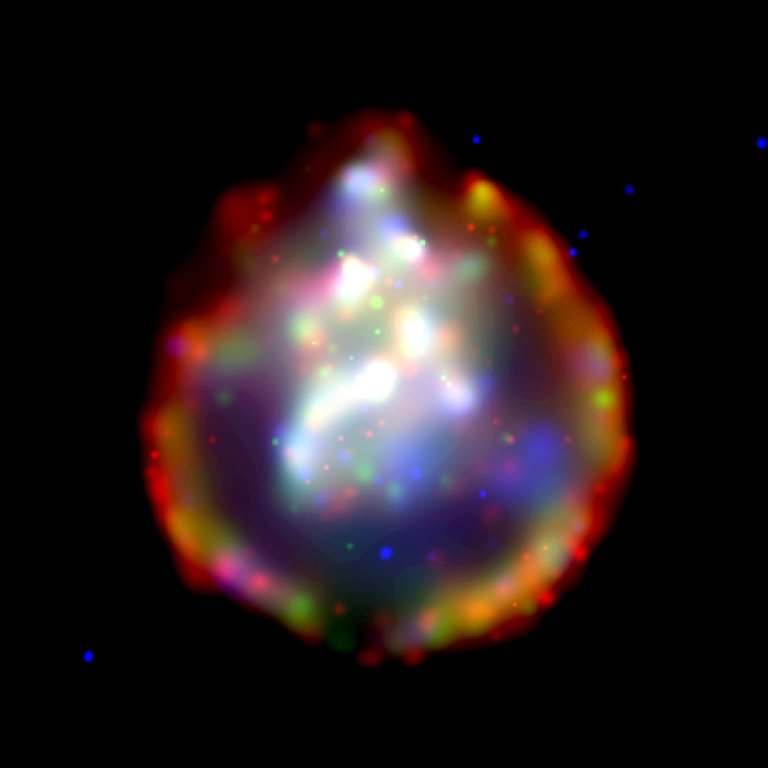
Nearly all of the atoms in your body were once cooked in the nuclear furnace of an ancient supernova. – Frances Collins
The story of us began in the stars. The universe expanded after the Big Bang, forming atoms of hydrogen and helium. The atoms gathered in galaxies where they came in handy as fuel for stars. When stars died (supernova) new atoms were released – including carbon and oxygen, happily for us. By and by, over 8 billion years, planets were formed and Earth’s story began.
Photo (NASA Images): Star that exploded in a supernova leaving a ring that’s rich in oxygen.
A beautiful star-metaphor appeals to my sense that our cosmic journey has meaning:
The universe is made of stars, not atoms – Muriel Rukeyser
The /Xam San people of Southern Africa knew that humans were related to the stars in a mysterious way. The /Xan suffered a slow genocide in the 1800s but their words remain. Their stories tell us that the stars are closely connected to humans:
“The stars know the time at which we die.” –Díä!kwain, 1876
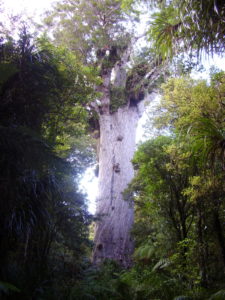
We breathe in O2 and breathe out CO2. But trees do the opposite: they breathe in CO2, and breathe out O2. That’s why trees are so important on the planet – we’ve pumped out too much CO2 – because they store carbon in their wood. Kauri trees can store a lot of carbon; they’re the largest rainforest trees in the world.
Photo: the ancient giant kauri tree, Tāne Mahuta (‘god of the forest’), in New Zealand.
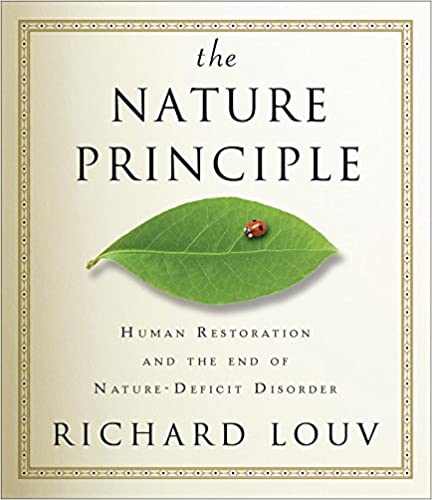
When truly present in nature, we use all our senses at the same time, which is the optimum state of learning. ― Richard Louv, The Nature Principle
Direct exposure to the natural world is essential for healthy childhood development. Forest schools are springing up all over the world to give children outdoor experiences. I’m a trustee for a new Nature School (in Dunedin, New Zealand) which combines creative play with skill-teaching (bushcraft, beekeeping etc).
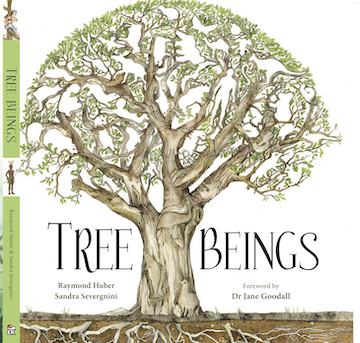
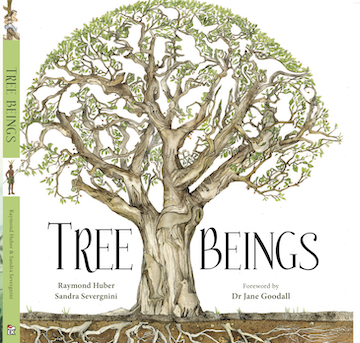
My new children’s book, Tree Beings is here. Trees are the oldest living things; they create rainfall, soil, and animal habitats; and trees fight climate change. Readers will get to know trees through tree science and the true stories of people who love trees. There’s the scientist who discovered how trees ‘talk’; a boy who mobilized the world’s children to plant trees; the first brave tree-hugging women; and a man responsible for trillions of tree-plantings. The foreword is by Jane Goodall and the book is beautifully illustrated by Sandra Severgnini.
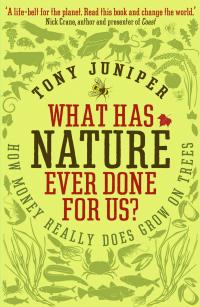
Tony Juniper’s book What Has Nature Ever Done For Us? brilliantly proves that money really does grow on trees. Nature is the basis of our economic lives and is worth $100 trillion/year to the global economy. But we use up our yearly budget of resources in about 8 months and after that we are destroying our natural capital. Juniper lists the huge benefits we get from healthy soil, plants, light, clean water, and animals, and shows it makes economic sense to care for them and respect them. Pollinators, for example, are vital for our food supply: of the 100 most important food crop plants, 71 are pollinated by bees. Juniper is hopeful we can protect the bees, for example, by planting ‘bee roads’ of flowering plants between our crops.
Everyone who has even a small garden can help with this.
There is a kind of library in the cells of your body. Inside each cell are tiny molecules which are digesting, healing, sensing, supporting and energising you. Most of this is done by protein molecules – there are 60,000 different proteins in the body; such as enzymes (for chemical reactions) and hormones (to send messages). We make proteins when we need them (eg. we build antibodies when we’re attacked by viruses). In his wonderful book, Our Molecular Nature, David Goodsell writes about proteins:
We must be able to build each one exactly when and where it is needed, using only the materials available in the diet.
This process is accurate because each cell has a ‘library’ inside it (called DNA) which contains the instructions to build the molecules. This amazing library is used every second of your life. DNA has 6 billion bits of information – about the number of books in a big library.
Ultimately, a single cell, when paired with an appropriate mate, can build an entirely new human being, molecule by molecule.
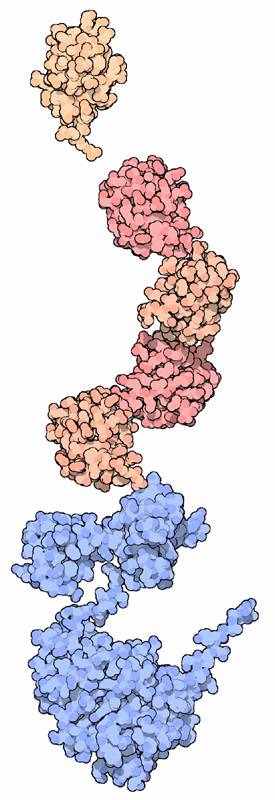
Using this blueprint, proteins are built in chains from smaller molecules called amino acids. Like letters of an alphabet, there are only 20 amino acids arranged to create thousands of different proteins. Some proteins last a long time, others are disassembled after a few minutes. (This allows the body to respond rapidly). The illustration shows ubiquitin, a protein found throughout your body. Ubiquitin’s job is to mark proteins for destruction.
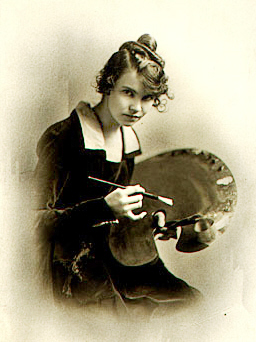
Meet Wanda G’ag (it rhymes with blog) one of the finest children’s book illustrators. Her masterpiece is Millions of Cats (1928) the story of a lonely old couple who attract ‘millions and billions and trillions of cats‘. The pictures roll like waves across the pages; clouds, trees, hills, and cats all swept along in the flow of the story. The black and white gives it a slightly unsettling folktale vibe. As a child I loved the army of cats drinking a pond in seconds, and the final catastrophic cat-scrap. And try to find her bizarre but cute book Nothing At All, about an invisible dog.
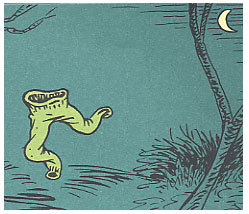
It was 1963, and I was terrified on my first day at school. I sat on the hard grey carpet mat, and the teacher read Horton Hatches the Egg to the class. I became so engrossed I didn’t even notice my mother slip out. That loyal elephant helped me get through that watershed day without too many waterworks. Soon I had other beloved Seuss friends at school including the Pale Green Pants and the Zizzer Zazzer Zuzz. Seuss thrived on the constraints of the English language – for Green Eggs and Ham he was given a 50 word vocabulary list to work with, and created a classic. And take heart writers, his first book was rejected 27 times.
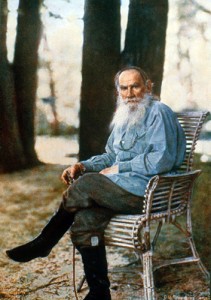
There is only one time that is important: Now. – Tolstoy
The wisdom in Tolstoy’s Twenty-Three Tales (1903) always inspires me. These classic folk tales include: How Much Land Does a Man Need? (very little, it turns out); The Three Questions (eg. What should I do with my time?); and A Grain as Big as a Hen’s Egg (the power of organic gardening).